
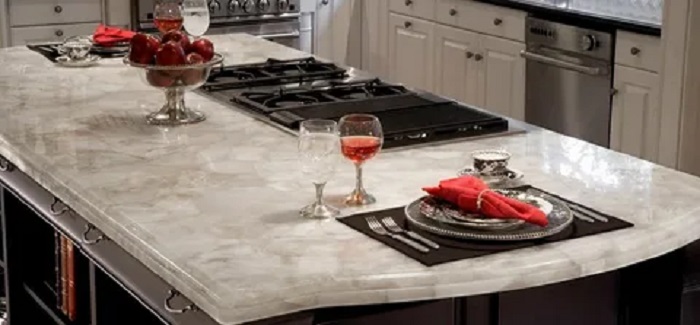
Artificial stone countertops are a practical solution for kitchens and bathrooms, combining durability, hygiene, and a stable appearance for years to come. They are resistant to moisture and household stains, easy to clean, and allow for a variety of designs: from straight lines to curved elements, sinks, and splashbacks, all matched to the interior and popular quartz countertop colors.
Installing these countertops requires precise measurements, reliable subfloor preparation, and careful joining of the elements to ensure minimal joints and long-lasting durability. Proper installation takes into account loads, clearances, cutouts for cooktops and sinks, and final sealing, which determines the furniture’s protection and the service life of the surface.
Advantages of Engineered Stone for Kitchen and Bathroom Countertops
Engineered stone for kitchen and bathroom countertops is valued for its combination of practicality and durable aesthetics: the material maintains its appearance under daily wear and tear and is suitable for complex shapes. Its uniform structure tolerates regular cleaning and contact with household chemicals well, remaining convenient for use in wet and heavily used areas.
Key advantages include wear resistance, hygiene, and repairability, as well as technological advantages such as seamless joints and excellent heat resistance. All this makes engineered stone a versatile solution for countertops, integrated sinks, and splashbacks, where both durability and a neat appearance are important.
Why is engineered stone practical in everyday life?
Wear resistance manifests itself in its resistance to everyday impacts: friction, minor impacts, and regular contact with water and detergents. With proper use, the surface remains smooth and neat for a long time, and light traces of use can often be removed with maintenance without replacing the entire countertop.
Hygiene is ensured by the fact that the material generally has a dense structure and does not promote the accumulation of dirt deep within the surface. This is especially important for kitchen food preparation areas and bathrooms, where moisture and cosmetics are constantly present; Cleaning becomes easier, and the risk of stubborn stains is reduced.
- Repairability: Localized scratches, abrasions, and minor chips can often be removed by sanding or resurfacing, extending the life of the surface.
- Seamless: Elements can be joined so that the joint is minimally noticeable, and sometimes virtually undetectable; This improves hygiene and visual integrity.
- Heat resistance: the material can withstand short-term temperature changes, which is important in the kitchen; however, to maintain a pristine appearance, it is recommended to use hot pads.
Key properties: seamlessness and durability
Seamlessness is one of the most noticeable advantages in terms of installation: a countertop can be assembled from several parts with neat joints, and integrated solutions (for example, a sink and sideboards) can be created with a visually seamless line. This improves appearance and reduces the number of vulnerable spots where water and dirt typically accumulate.
Heat resistance and repairability complete the picture: the surface is designed to withstand everyday wear and tear, and if defects appear, it is often possible to repair it without dismantling the entire structure. As a result, engineered stone remains a convenient and cost-effective option for kitchen and bathroom surfaces where durability, cleanliness, and precise geometry are important.